Strengthening Sri Lanka’s Global Research Presence: University of Sri Jayewardenepura and SLIIT Mark Historic U.S. Patent Success

SLIIT Secures Historic First U.S. Patent for Breakthrough Nanoparticle Innovation
February 1, 2026
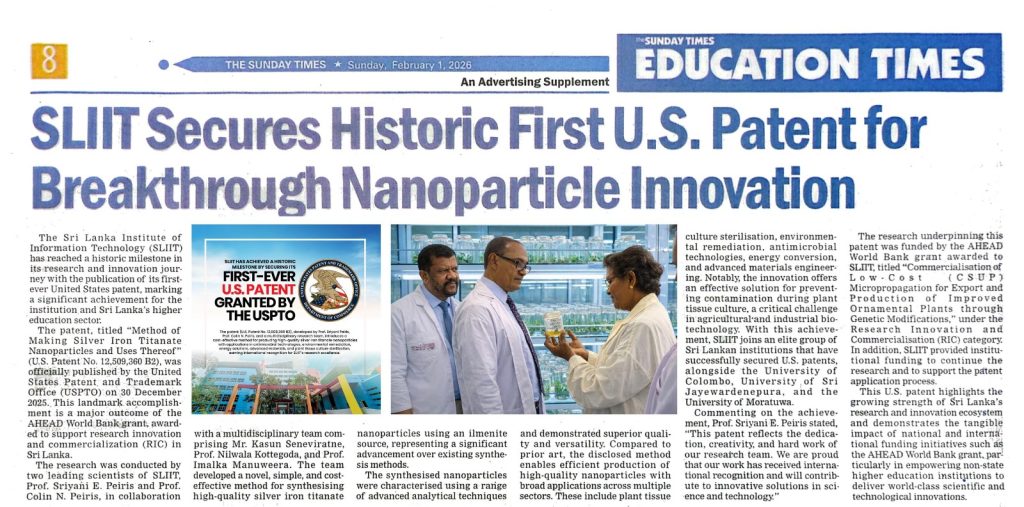
The Sri Lanka Institute of Information Technology (SLIIT) has achieved a historic milestone in research and innovation with the publication of its first-ever United States patent. This landmark achievement represents a significant breakthrough for the institution and marks an important advancement for Sri Lanka’s higher education sector.

A Pioneering Achievement in Nanotechnology
The patent, titled “Method of Making Silver Iron Titanate Nanoparticles and Uses Thereof” (U.S. Patent No. 12,509,360 B2), officially published by the United States Patent and Trademark Office (USPTO) on December 30, 2025. This accomplishment represents a major outcome of the AHEAD World Bank grant, awarded to support research innovation and commercialization (RIC) initiatives in Sri Lanka.
The Research Team and Their Innovation
The groundbreaking research was conducted by two leading scientists from SLIIT—Prof. Sriyani E. Peiris and Prof. Colin N. Peiris—in collaboration with a multidisciplinary team comprising Mr. Kasun Sevenaratne, Prof. Niwala Kottegofa, and Prof. Imalka Munaweera.
The team developed a novel, simple, and cost-effective method for synthesizing high-quality silver iron titanate nanoparticles using an ilmenite source. This innovation represents a significant advancement over existing synthetic methods.
Technical Innovation and Applications
The synthesized nanoparticles demonstrate superior quality and versatility compared to prior art. The disclosed method enables efficient production of high-purity nanoparticles with broad applications across multiple sectors, including:
– Plant tissue culture sterilization
– Environmental remediation
– Antimicrobial technologies
– Energy conversion
– Advanced materials engineering
Notably, the innovation offers an effective solution for preventing contamination during plant tissue culture, addressing a critical challenge in agricultural and industrial biotechnology.
Funded by International Recognition
The research underpinning this patent was funded by the AHEAD World Bank grant awarded to SLIIT, titled “Commercialisation of Low-Cost CSUP Micropropagation for Export and Production of Improved Ornamental Plants through Genetic Modifications,” under the Research Innovation and Commercialisation (RIC) category.
In addition, SLIIT provided institutional funding to continue the research and to support the patent application process through various stages of development.
Significance for Sri Lankan Higher Education
This U.S. patent highlights the growing strength of Sri Lanka’s research and innovation ecosystem. It demonstrates the tangible impact of national and international funding initiatives in empowering universities and higher education institutions to deliver world-class scientific and technological innovations.
With this achievement, SLIIT joins an elite group of Sri Lankan institutions that have successfully secured U.S. patents, alongside the University of Colombo, University of Sri Jayewardenepura, and the University of Moratuwa.
Expert Commentary
Commenting on the achievement, Prof. Sriyani E. Peiris stated, “This patent reflects the dedication, creativity, and hard work of our research team. We are proud that our work has received international recognition and will contribute to innovative solutions in science and technology.”
The patent represents not only a technical achievement but also validates the capacity of Sri Lankan researchers to compete at the highest levels of international innovation and intellectual property development.
Looking Forward
This milestone achievement underscores the importance of sustained investment in research and development within Sri Lanka’s higher education sector. It serves as an inspiration for other institutions and researchers to pursue excellence in innovation and to seek international recognition for their work.
The successful patent application also demonstrates the effectiveness of collaborative research models and the critical role of institutional and international funding in supporting transformative research outcomes.